

As an Amazon Associate I earn from qualifying purchases.
A search for a creatine supplement for women returns pages of near-identical tubs, all promising strength, tone and no bloating. The hard part isn’t finding creatine — it’s figuring out which formula fits your day, your stomach and your routine. Some are plain monohydrate, some add collagen, some come as gummies you’ll actually remember to take. This guide walks through ten options, what’s in each one, and who should skip it. By the end, you’ll know which one matches how you actually live.
Our Picks
| # | Product | ||
|---|---|---|---|
| 1 | 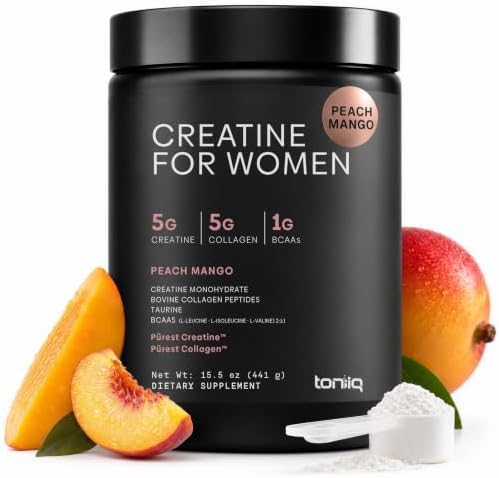 | Toniiq Full Clinical Dose Best Overall | Check Price |
| 2 |  | Double Wood Creatine Capsules Best Pure Capsules | Check Price |
| 3 |  | Wellah Creatine for Women Best Flavored Powder | Check Price |
| 4 |  | Arrae Creatine Gummies Best Gummies | Check Price |
| 5 |  | O Positiv FLO Creatine Best with Electrolytes | Check Price |
| 6 |  | Native Essentials Creatine Collagen Best Collagen Blend | Check Price |
| 7 |  | Jacked Factory Women's Creatine Best Unflavored Powder | Check Price |
| 8 |  | CON-CRET Creatine HCl Best HCl Capsules | Check Price |
| 9 |  | HZZYPLANT Creatine Softgels Best Softgels | Check Price |
| 10 |  | Micro Ingredients Creatine Hydration Best Hydration Powder | Check Price |
1. Toniiq Full Clinical Dose Creatine
Best for: Women who want one scoop with everything in it.
The headline here is the dose. You get 5,000 mg of creatine monohydrate from NNB Nutrition, which is the amount most studies use. It also carries 5,000 mg of hydrolyzed bovine collagen peptides — the listing says that’s more than 2.5x what other women’s creatine brands include. Add 2,000 mg taurine and 1,000 mg BCAAs at a 2:1:1 ratio, and one scoop covers 13,000 mg of actives. That means you don’t need a separate collagen powder or an amino acid drink.
Pros
- Full 5,000 mg creatine monohydrate per serving
- Highest listed collagen dose in this group
- Five-point testing program on every lot
Cons
- Fixed all-in-one blend you can’t adjust
2. Double Wood Creatine Capsules
Best for: People who hate mixing powder and want no fillers.
These are capsules, so there’s no shaker, no scoop and no chalky aftertaste. The listing says the only thing inside is micronized creatine monohydrate, with no added fillers, in a vegetarian capsule. It’s also described as keto friendly and not synthesized from animal sources, which keeps it open to vegetarians. That makes it a simple choice for anyone who wants creatine and nothing else.
Pros
- Only micronized creatine monohydrate, no fillers
- Vegetarian capsules, keto friendly
- No mixing, no shaker, no grit
Cons
- Copy lists two different capsule strengths
3. Wellah Creatine for Women
Best for: Women who want a flavored drink they’ll finish.
This is a creatine monohydrate powder with real flavor choices: Strawberry Lemonade, Blueberry Pomegranate, and Unflavored. Each bottle gives 50 servings, which the listing treats as a sustained supply rather than a short trial. It also adds dandelion and cranberry extract, which is an unusual pairing next to plain creatine.
Flavor is the whole point here, and it’s also the limit.
Pros
- Three flavor options, including unflavored
- 50 servings listed per bottle
- Tested by independent ISO-accredited labs
Cons
- Added dandelion and cranberry extracts
4. Arrae Creatine Gummies
Best for: Women who won’t touch a shaker or a capsule.
Gummies remove the last excuse. Each serving carries 5 g of creatine monohydrate, with no powder, no scoop and no mixing. The listing points out that women can have up to 75% less creatine than men, and that levels drop during hormonal changes like the menstrual cycle and menopause. That’s the reasoning behind the format.
Pros
- 5 g creatine monohydrate per serving
- No powder, no mixing, no shaker
- Vegan and non-GMO formula
Cons
- Fat-metabolism claims go beyond creatine alone
5. FLO Women’s Creatine + Electrolytes
Best for: Women who want creatine and hydration together in a drink.
FLO pairs a clinically-studied dose of creatine monohydrate with electrolytes for cellular hydration. It comes from O Positiv Health, the company behind URO, so it’s built by a women’s health brand rather than a general sports label. One scoop goes into any liquid you like, and the listing frames it as daily support for brain health, strength and tone, recovery, and hydration.
Pros
- Creatine plus a full electrolyte blend
- Vegan and third-party tested
- 30-day happiness commitment from the brand
Cons
- 30 servings is less than the listed 6-week window
6. Native Essentials Creatine Collagen
Best for: Women who want strength and skin support together.
This one gives 5 g creatine monohydrate and 5 g hydrolyzed collagen peptides in the same serving. The collagen is Types I & III, aimed at skin elasticity, hair, nails, and connective tissue. The listing makes a fair point: most creatine powders chase muscle only, while this one also feeds the structure around it.
Pros
- 5 g creatine and 5 g collagen per serving
- Types I & III collagen for skin and joints
- Fine 200-mesh powder mixes smoothly
Cons
- Collagen arrives with every creatine dose
7. Jacked Factory Women’s Creatine
Best for: Women who want an unflavored powder with extras.
Jacked Factory keeps the creatine at a full 5,000 mg with no loading phase and no proprietary blend hiding the amounts. Beyond that, each scoop adds 3,000 mg grass-fed bovine collagen hydrolysate for skin, hair and nails, plus 1,000 mg grass-fed colostrum for gut and immune support. Every active is clearly dosed on the label.
Pros
- Full 5 g creatine monohydrate per scoop
- 3,000 mg grass-fed collagen plus colostrum
- Unflavored, no artificial dyes
Cons
- Not vegan, since collagen and colostrum are bovine
8. CON-CRET Creatine HCl Capsules
Best for: Women who get stomach upset from monohydrate powder.
CON-CRĒT uses creatine HCl, not monohydrate. The listing claims 59X better solubility than monohydrate and says it’s easier on the stomach, without the bloating or water retention some people get. Each 750 mg capsule is described as delivering the same benefit as 5,000 mg of monohydrate, which is why the pills stay small.
The convenience is real: no scoop, no shaker, and a few capsules travel anywhere. The trade-off is that you’re trusting an equivalence claim rather than counting grams of the form most research uses. It’s also marketed for cognitive support and mental clarity, which reaches past the gym.
Pros
- HCl form sold as easier on the stomach
- Small 750 mg capsules, no mixing
- Certified vegan, gluten-free, and kosher
Cons
- You rely on an equivalence claim, not grams
9. HZZYPLANT Creatine Softgels
Best for: Women who want a softgel instead of a hard capsule.
These are softgels rather than tablets or powder, and the listing calls them fast-absorbing and easy to swallow. The creatine is monohydrate, described as the widely used form, with 5,000 mg in the serving. The formula is sugar free, non-GMO, and gluten free, and the listing says each softgel is tested for purity and free from fillers.
Pros
- Softgel format, no mixing needed
- 5,000 mg creatine monohydrate listed
- Sugar free, non-GMO, gluten free
Cons
- Copy mixes per-serving and per-softgel dosing
10. Micro Ingredients Creatine Hydration Powder
Best for: Women who want creatine, hydration and beauty from a daily scoop.
This strawberry powder packs a lot into one serving: 5 g micronized creatine monohydrate, a full electrolyte profile with 750 mg potassium, 75 mg magnesium, 45 mg sodium, and 35 mg calcium, plus 2 g multi collagen peptides, hyaluronic acid, biotin, and vitamin C. There’s also a 10-strain probiotic blend with 1 billion CFU and 2 g dietary fiber from chicory inulin.
Pros
- Creatine plus electrolytes and collagen combined in a scoop
- Probiotic blend and fiber included
- Sugar free and third-party lab tested
Cons
- Many ingredients combined in a blend, hard to isolate
Also Worth Considering
Three more that didn’t make the main list, but are worth a look if none of the ten above quite fits.
Create Creatine Monohydrate Gummies Women are watermelon creatine monohydrate gummies, 90 count, made for both women and men. Worth a look if flavor and convenience matter more to you than controlling the exact dose.
BEAM Creatine delivers 5 g micronized creatine monohydrate per serving, unflavored, third-party tested, and marketed for strength, growth, recovery, and cognitive support, with 30 servings per tub.
Which Creatine Supplement Is Best for Women?
Start With the Form: Monohydrate or HCl
Most products here use creatine monohydrate, the form with the longest research history behind it. One uses creatine HCl, sold on claims of better solubility and less stomach trouble. Neither is wrong, but they ask different things of you. Monohydrate gives you a clear gram number to track. HCl asks you to trust an equivalence claim — one brand says its 750 mg capsule matches 5,000 mg of monohydrate. If you like knowing exactly how many grams you take, monohydrate is easier to reason about. If powder upsets your stomach, the HCl capsule is the one to try. Don’t switch forms every few weeks either; pick one and give it a fair run. And if a label hides the form inside a proprietary blend, that’s a reason to walk away.
Pick a Format You’ll Actually Stick With
Creatine only works if you take it most days, which makes format a real decision rather than a detail. Powder is the most flexible — stir it into water, juice or a shake, and split a scoop if you want to. Capsules and softgels skip the shaker and travel well, but a full daily dose usually means more than one pill. Gummies are the easiest of all to remember and the hardest to adjust, since each piece is a fixed dose. Think about where you’ll take it: at home with a shaker, at a desk with a water bottle, or in a gym bag. The format that fits that moment is the one you’ll still be using in three months. Convenience beats theory here.
Check the Dose and the Serving Count
The number on the front of the label isn’t always the number you get. Look for 5,000 mg (5 g) of creatine monohydrate per serving, which is the amount most studies use, and check that the serving size is one scoop — not two. Then look at the serving count. A tub with 30 servings covers a month of daily use; 50 servings stretches further. That matters because consistency is the whole game with creatine, and a container that runs out mid-habit is easy to abandon. Also check whether the label calls for a loading phase. Most of the products here don’t. If the numbers stay vague, or the creatine sits inside a blend with no grams listed, keep looking.
Look at What Else Is in the Scoop
Many women’s creatine products aren’t just creatine. Some add collagen peptides for skin, hair, nails and joints. Some add electrolytes for hydration, taurine and BCAAs for endurance, or probiotics and fiber for gut health. None of that’s bad — but it changes what you’re buying. If you already take a collagen powder, a creatine-and-collagen blend means watching your total intake and possibly doubling up. If you want to adjust your creatine dose up or down, an all-in-one formula locks you in. Single-ingredient products give you control; blends give you convenience. Decide which one you actually want before you compare labels, because the extras are the main thing that separates these products from each other.
Read the Testing and Facility Details
Creatine is easy to fake, so the testing lines matter. Look for third-party testing, which means a lab outside the brand checked the product. Look for a GMP-certified or cGMP-compliant facility, which speaks to how it’s made. Some listings go further: one here describes a five-point program covering heavy metals in raw material and finished product, ingredient assay, fill weight and microbiology. Another names ISO-accredited labs. You don’t need every certification, but you should see at least one clear testing claim and a named manufacturing standard. When two products look similar on paper, this is a fair tiebreaker.
Narrowing your choice comes down to your own routine. If you already take collagen or electrolytes, choose a plain monohydrate and keep the extras separate. If you know you won’t mix a powder, a capsule, softgel or gummy will beat a better formula you never use. If you want one scoop to do everything, pick a blend and check that the creatine still hits 5 g. Start there, and the list above shrinks fast.
Common Mistakes to Avoid When Buying Creatine Supplements for Women
Assuming “For Women” Formulas Work Differently
A lot of packaging is aimed at women, and it’s easy to read that as a different active ingredient. Usually it isn’t. The creatine in most of these products is creatine monohydrate or creatine HCl — the same compounds sold to men. What actually changes is the flavor, the convenience, and the extras like collagen, electrolytes or probiotics. Part of the reason a women’s label exists is physiological: one listing here notes that women can have up to 75% less creatine than men, and that levels fall during the menstrual cycle and menopause. But that’s an argument for taking creatine, not for a special version of it. So don’t let the word “women” on the front decide anything. Read the ingredient list, find the grams of creatine, and check the testing lines. Those three things tell you far more than the marketing does.
Letting Flavor and Format Drive the Decision
Taste and convenience matter — you won’t take something you hate. But they shouldn’t be your only filter. A flavored powder can carry added extracts you didn’t ask for. A gummy is easy to remember and hard to adjust, since each piece is a fixed dose. A capsule means no shaker, but a full daily dose often means more than one pill. None of these is a mistake on its own. The mistake is choosing the format first and hoping the dose works out. Flip the order: confirm the creatine amount per serving, check what else is in it, then pick the format that fits your routine. If you train at home with a shaker, powder is simple. If you’re at a desk all day, capsules travel better. If you’ll forget anything that isn’t chewable, take the gummy and accept the fixed dose.
Misreading the Dose and the Serving Count
This is the most common slip. The front of the label says 5,000 mg, and it’s easy to assume that’s one scoop. Sometimes it’s two. Sometimes the number appears per softgel in one line and per serving in another — one product here does exactly that, and another lists two different capsule strengths in the same description. Read the serving size line first, then the creatine grams, then how many servings the container holds. A tub sized for daily use over a month lasts the month; a larger tub goes further. That matters because creatine works through consistency, not through big single doses. If the creatine sits inside a proprietary blend with no grams listed, you can’t tell what you’re getting, so skip it. There’s no shortage of products that print the numbers clearly.
Overlooking Add-Ons You Already Take
Collagen is the big one. Several products here pair 5 g of creatine with 3 to 5 g of collagen peptides. That’s a real amount, and if you already stir collagen into your coffee, you’d be doubling up without meaning to. The same goes for electrolytes if you use a hydration mix, and for probiotics if you take one separately. None of that’s dangerous, but it’s wasteful and it makes your routine harder to track. Before you buy a blend, list what you already take. If collagen is on that list, a plain monohydrate is the cleaner choice, and you keep control of both doses. If your routine is empty and you want one scoop to cover several things, a blend earns its place. Match the product to the gap in your routine.
Expecting Fast Results and Quitting Early
Creatine doesn’t work like a pre-workout. You won’t feel it on day one. The effect builds as your muscles saturate, and that takes weeks of daily use. One listing here says plainly to take it daily for 6 weeks to feel optimum results — and a single container falls short of the full stretch, so the window runs past the first tub. That’s worth knowing before you start. People often quit at the two-week mark because nothing dramatic happened, then decide creatine doesn’t work for them. Set a realistic timeline, take it on rest days too, and judge it after a couple of months of consistency. The other half of this mistake is switching products every few weeks. If you keep changing forms and blends, you never give any of them a fair run. Pick one and be patient.
The mistakes that matter most are quiet ones: assuming the label is aimed at your biology, choosing on taste alone, and misreading what a serving actually is. Get the dose, the extras and the format right, and the rest is just consistency.
Frequently Asked Questions
Do I need a creatine made just for women?
How much creatine should I take each day?
The widely used amount is 5 g (5,000 mg) of creatine monohydrate per day, and that’s the dose most of the products here are built around. Check the serving size on your label, because some products need two scoops or several capsules to reach it. You don’t need to cycle on and off, and rest days count too.
Is monohydrate better than HCl?
Do I need a loading phase?
Most of the products here say no loading phase is required. Taking 5 g daily builds your muscle stores over a few weeks, which is slower than a loading phase but easier to stick with. If a label does call for loading, follow what it says rather than guessing at a number.
Can I take creatine with coffee or on an empty stomach?
You can mix creatine into most drinks, and the listings here don’t restrict when you take it. What matters more is taking it every day, including rest days. If a powder upsets your stomach, take it with food or switch to capsules. Pick a time you won’t forget and keep it there.
Why do some women’s creatines include collagen?
The most useful takeaway is simple: the word “women” on the label tells you almost nothing, and the numbers tell you almost everything. Find the grams of creatine per serving, check what else rides along in the scoop, and pick the format you’ll genuinely use every day. Get those three right, and any of the products above can do its job.
